
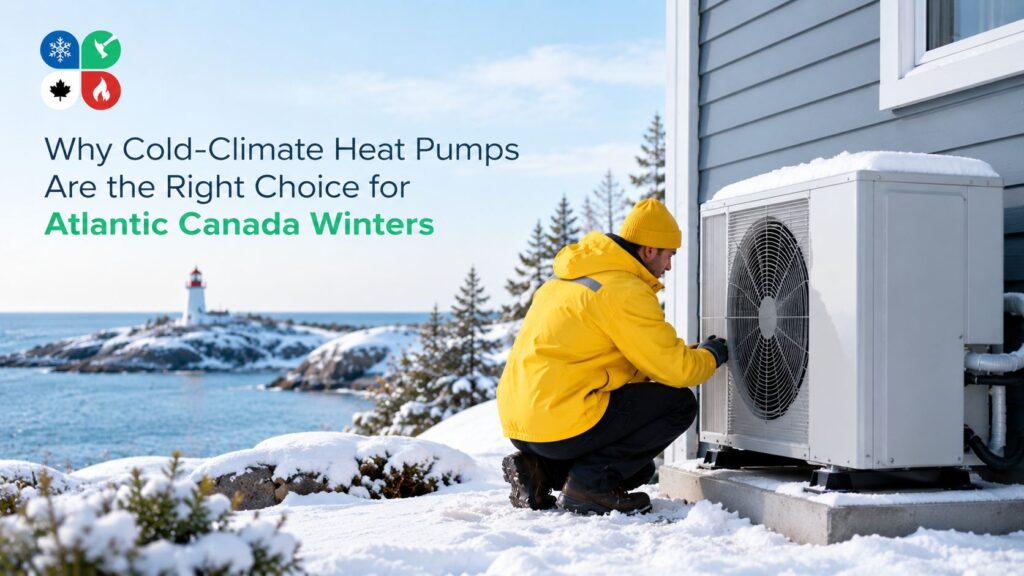
Heat pump marketing rarely draws this distinction clearly, and it matters more here than almost anywhere else in Canada. Atlantic Canada’s winters combine sustained sub-zero temperatures with damp maritime air, and that specific combination is exactly where a standard heat pump’s performance curve falls apart. Here is what actually separates a cold-climate system from a standard one, and why that difference decides whether a heat pump keeps a home comfortable through February or quietly hands the job over to expensive backup heat.
What “Cold-Climate Rated” Actually Means
Every heat pump on the market has a capacity rating, but that number is measured at a standard test condition of about 8°C, a temperature Atlantic Canada spends relatively little of its heating season at. As outdoor temperature drops, every heat pump loses some heating capacity, since there is simply less heat energy available in the outdoor air to extract. The question that actually matters is how much capacity a specific unit retains as the mercury keeps falling, and that is where cold-climate engineering earns its name.
A genuine cold-climate heat pump typically relies on a few specific design features working together:
- Variable-speed (inverter) compressors that ramp output up and down continuously rather than simply switching on and off, allowing the system to keep producing meaningful heat even as outdoor conditions get harder to draw from.
- Enhanced vapor injection (EVI) technology, which injects additional refrigerant vapor into the compression cycle at low temperatures, boosting heating capacity specifically in the conditions where a standard system would be losing the most ground.
- Cold-climate refrigerant blends and expanded operating ranges, engineered to keep circulating effectively and avoid the performance cliff that standard refrigerant charges hit well before -15°C.
- Smarter defrost cycling, which manages the frost that naturally forms on an outdoor coil in damp, near-freezing conditions without stealing as much heat from the home during the defrost process itself.
Natural Resources Canada’s cold-climate specification requires qualifying units to maintain a meaningful share of their rated capacity at -15°C while keeping their heating performance (COP) in an efficient range, rather than collapsing toward simple electric-resistance backup. In practical terms, a properly selected cold-climate unit should still be delivering roughly 70% or more of its rated heating capacity at -15°C, a threshold a standard heat pump was never designed to hit.
Why Atlantic Canada’s Winters Are a Different Test Than Most of Canada
Cold-climate performance is not an abstract spec sheet exercise here; it is a direct response to a specific climate. Nova Scotia and the wider Atlantic region regularly see extended stretches below -10°C, and that cold arrives paired with damp, salt-laden coastal air rather than the dry cold found further inland. Damp cold is a harder environment for a heat pump to work in than dry cold at the same temperature, since moisture in the air affects both heat transfer at the outdoor coil and how aggressively frost builds up during normal operation.
Older housing stock across the province adds another layer to the problem. Much of it was originally built around oil furnaces and electric baseboard heat, often with inconsistent insulation and air sealing from one renovation era to the next. A heat pump that is already struggling to hold its rated capacity in the cold has even less margin to compensate for a leaky building envelope. For homeowners weighing whether their specific home and climate zone genuinely call for cold-climate equipment rather than a standard system, cold-climate heat pumps in Nova Scotia provides a closer look at the climate factors, equipment considerations, and assessment involved before a system is recommended.
Cold-Climate Heat Pumps vs. the Alternatives
| Heating System | Performance at -15°C | Where It Falls Short in Atlantic Canada |
| Cold-climate heat pump | Retains roughly 70%+ of rated capacity | Highest equipment cost of the heat pump options |
| Standard (non-cold-climate) heat pump | Capacity drops sharply, often leaning on backup heat | Undersized for real winter demand despite an adequate summer spec sheet |
| Electric baseboard | Consistent output regardless of temperature | Highest ongoing electricity cost of any option, no cooling function |
| Oil furnace | Consistent output regardless of temperature | Highest fuel cost volatility, combustion byproducts, no cooling function |
A cold-climate heat pump is the only option on this list that combines cold-weather performance with efficiency gains over resistance-based heating while also providing cooling in summer. The trade-off is a higher upfront equipment cost than a standard heat pump, which is why confirming the specific model’s rated performance at -15°C, not simply relying on its brand name or general reputation, is one of the most useful questions to ask before signing a quote. When comparing cold-climate heat pump options in Nova Scotia, we look at the equipment’s rated performance alongside the home’s actual design temperature and heating requirements rather than selecting equipment based on brand reputation alone.
What Actually Happens When a Standard Heat Pump Gets Installed Here Anyway
This is not a hypothetical risk; it is a pattern seen often enough in this region to be predictable. A standard heat pump installed without cold-climate specifications will typically perform well through fall and into early winter, then start leaning harder on backup electric resistance heat as temperatures drop through December and January. Homeowners usually notice this first as a power bill that climbs faster than expected, followed by a home that feels less consistently warm on the coldest nights even though the thermostat setting has not changed.
The frustrating part is that this failure mode is largely invisible until it happens, since a standard heat pump’s spec sheet at 8°C can look nearly identical to a cold-climate model’s spec sheet at the same temperature. The gap only shows up once outdoor temperatures actually drop, which is precisely when a homeowner has the least appetite for troubleshooting a system that was supposed to be handling the job.
Efficiency and Cost Considerations
Cold-climate heat pumps are generally more expensive upfront than standard heat pumps, and meaningfully more efficient than electric baseboard heating or an oil furnace over a full heating season, since they move heat rather than generating it directly. The exact savings any specific home sees depend on the home’s current heating source, its insulation and air sealing, local electricity rates, and how the specific cold-climate model performs at that home’s design temperature, so a generic percentage savings figure would not be an honest answer without those numbers. What can be said with confidence is that the efficiency advantage compounds specifically on the coldest days of the year, which is exactly when a standard system or a resistance-based system is working hardest and costing the most to run.
What to Look for When Choosing a System
A few checks separate a cold-climate installation done properly from one that only sounds like it on paper:
- Ask for the specific model’s rated heating capacity and COP at -15°C, not its rating at 8°C or its general brand reputation.
- Confirm the system has been sized using an actual heat loss calculation for your home, not a square-footage estimate.
- Check that the installer is quoting a unit that qualifies under Natural Resources Canada’s cold-climate specification, rather than a standard model marketed with cold-weather language.
- Ask how the system’s defrost cycle is managed, since poor defrost design in damp coastal conditions can meaningfully affect real-world performance.
FAQs
1. What makes a heat pump “cold-climate rated”?
A cold-climate heat pump uses design features like a variable-speed inverter compressor and enhanced vapor injection to keep delivering a meaningful share of its rated heating capacity as outdoor temperatures drop toward -15°C or lower, unlike a standard heat pump built around a mild-climate rating condition.
2. Do I really need a cold-climate heat pump in Nova Scotia?
For most of the province, yes. Nova Scotia regularly sees extended stretches well below -10°C combined with damp coastal air, conditions a standard heat pump was not designed to handle without leaning heavily on backup electric resistance heat.
3. How much more do cold-climate heat pumps cost than standard models?
Cold-climate units generally carry a higher equipment cost than standard heat pumps of similar capacity, though the exact difference depends on the specific brand, model, and system size being compared.
4. Can a cold-climate heat pump fully replace my oil furnace or electric baseboard heat?
In most Atlantic Canada homes, yes, when the system is properly sized and cold-climate rated, though some homeowners choose to keep a backup heat source available for the most extreme cold snaps.
5. How do I know if a heat pump is actually cold-climate rated and not just marketed that way?
Ask the installer for the specific model’s rated heating capacity and COP at -15°C rather than accepting general cold-weather marketing language, and confirm it qualifies under Natural Resources Canada’s cold-climate specification.
Choosing Equipment That’s Actually Built for This Climate
Atlantic Canada’s winters are not a mild edge case that most heat pumps can handle with a bit of margin to spare; they are a specific, demanding test that separates cold-climate engineering from standard equipment. Getting this right starts with choosing the right system, not just focusing on the installation. Mada Construction helps Nova Scotia homeowners select and install cold-climate-rated heat pump systems designed to perform through the region’s demanding winter conditions, with equipment choices based on the home’s heating requirements rather than a one-size-fits-all approach.