
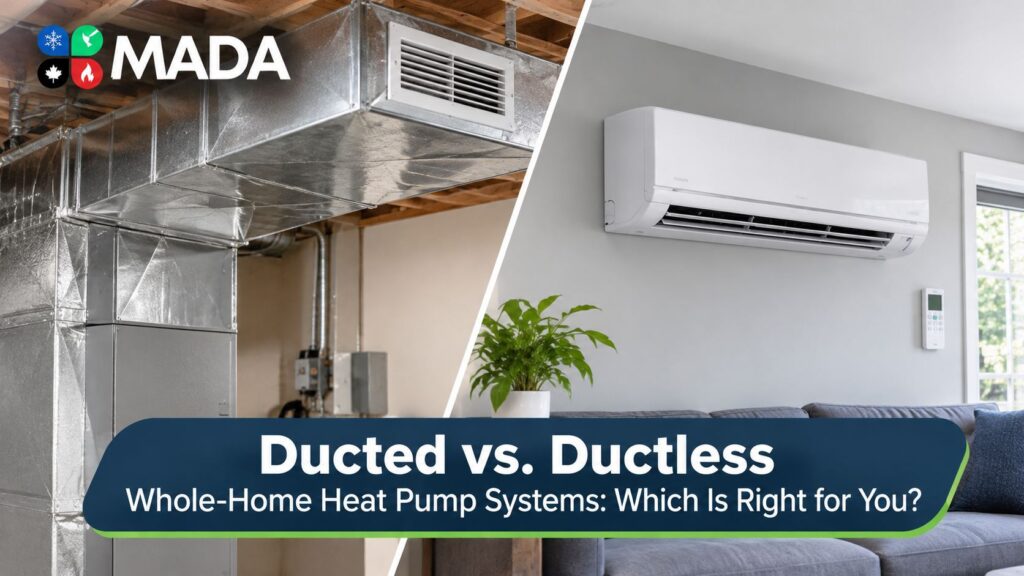
Once a homeowner decides they want heat pump coverage for the entire house rather than just one or two rooms, the next question is not whether to go ductless or ducted as separate categories; it is which approach actually delivers whole-home comfort better for their specific property. Here is how to think through that decision properly.
What Counts as a Whole Home System Today
A whole home heat pump system simply means every main living area is covered, not that the equipment has to be a single ducted unit. A traditional ducted system achieves this through one central outdoor compressor tied into a duct network reaching every room. A multi-zone ductless system achieves the same result differently, with several indoor units, often four to eight depending on the home, each serving its own room, connected to one or more outdoor compressors. Both paths genuinely qualify as whole-home coverage. The real differences show up in installation, day-to-day control, and cost. For a better understanding of the options available for your property, explore our whole-home heat pump installation services in Nova Scotia.
How a Ducted Whole-Home System Works
A ducted system ties into or replaces an existing duct network, pushing heated or cooled air through the same vents a furnace once used. One thermostat controls the whole house, and all the equipment stays out of sight. This path tends to make the most sense when a home already has ductwork in reasonably good condition from an oil or gas furnace, since reusing that infrastructure is usually more cost-effective than building zone-by-zone coverage from scratch.
How a Multi-Zone Ductless System Delivers Whole-Home Coverage
A multi-zone ductless system covers the whole home with individual wall- or ceiling-mounted indoor units in each main room, all tied back to one or more outdoor compressors. Every zone can be set to its own temperature and run independently, so bedrooms can stay cooler overnight while a home office runs warmer during the day, something a single ducted thermostat cannot do without an added zoning system. This path tends to fit homes that were never built with ductwork at all, older character homes across Nova Scotia, and homes currently heated with electric baseboard where installing a full duct network would mean opening up walls and ceilings throughout the house. We help homeowners determine how many indoor units their property needs for full coverage through our whole-home ductless heat pump solutions, since the right number of zones depends entirely on the layout of the house.
Comparing the Two for Whole-Home Comfort
Neither path is universally better once whole-home coverage is the goal. A ducted system generally costs less overall when existing ductwork is reusable, controls the whole home from a single thermostat, and keeps equipment hidden. A multi-zone ductless system generally costs more per square foot of coverage but delivers genuine room-by-room control and requires no ductwork at all.
Which Path Fits Your Home
A few direct questions tend to settle this. Does the home already have ductwork from an oil or gas furnace in good condition? A ducted whole-home system is usually the more cost-effective path. Is the home older, character-construction, or heated with an electric baseboard with no ducts anywhere? A multi-zone ductless setup is almost always the more practical way to reach full coverage. Do different rooms genuinely need different temperatures throughout the day, such as a primary bedroom kept cooler while a main floor stays warmer? Ductless zoning handles that naturally, whereas a ducted system would need an added zoning upgrade to do the same thing.
Staging the Upgrade Room by Room or All at Once
This is one advantage worth calling out directly, since it rarely gets mentioned. A ducted whole-home system is typically installed as one project, covering every room from day one. A multi-zone ductless system can often be staged, starting with the two or three rooms that matter most and adding indoor units to the same outdoor compressor later, as long as that outdoor unit was sized with future expansion in mind from the start. For homeowners who want whole-home coverage eventually but need to spread the investment out, that flexibility is a genuine advantage ductless holds over a ducted install.
Cold Weather Performance Applies to Both
Whichever path a home takes, the equipment itself still needs to be rated for genuine Nova Scotia winters, well below freezing for extended stretches. Both ducted and ductless whole-home systems are available in cold-climate-rated configurations, and that rating matters more to real comfort than whether the system uses ducts or individual zones.
FAQs
1. Can a ductless system really cover a whole home, not just one or two rooms?
Yes. A properly sized multi-zone ductless system, with enough indoor units connected to one or more outdoor compressors, delivers full whole-home coverage, not just single-room heating and cooling.
2. Is a ducted system always cheaper for whole-home coverage?
Only when usable ductwork already exists. Without existing ducts, installing a full new duct network from scratch can cost more than an equivalent multi-zone ductless setup.
3. Can I start with ductless in a few rooms and add more zones later?
Yes, as long as the outdoor compressor is sized upfront to support the additional indoor units you plan to add, which is why it is worth planning for whole-home coverage even if the first phase only covers part of the house.
4. Does a ducted system give better airflow than ductless zones?
Both deliver strong, consistent comfort when properly sized. Ducted systems distribute air through vents, while ductless zones deliver it directly from each indoor unit, and neither is inherently better at maintaining temperature.
5. Which option adds more value to an older Nova Scotia home?
For most older homes without existing ductwork, a multi-zone ductless system tends to be the more practical path to whole-home value, since it avoids the cost and disruption of adding ducts to a house that was never built for them.
Getting Whole Home Comfort Right
Whole-home heat pump coverage is the goal either way, and the right solution depends on your home’s existing setup, how each room is used, and whether you prefer a complete installation or a phased upgrade. Mada Construction helps Nova Scotia homeowners navigate these decisions with practical, property-specific recommendations, taking into account comfort needs, installation requirements, and long-term energy efficiency. By focusing on what works best for each home rather than pushing a one-size-fits-all system, the team helps homeowners move forward with greater confidence in their investment and year-round indoor comfort.